
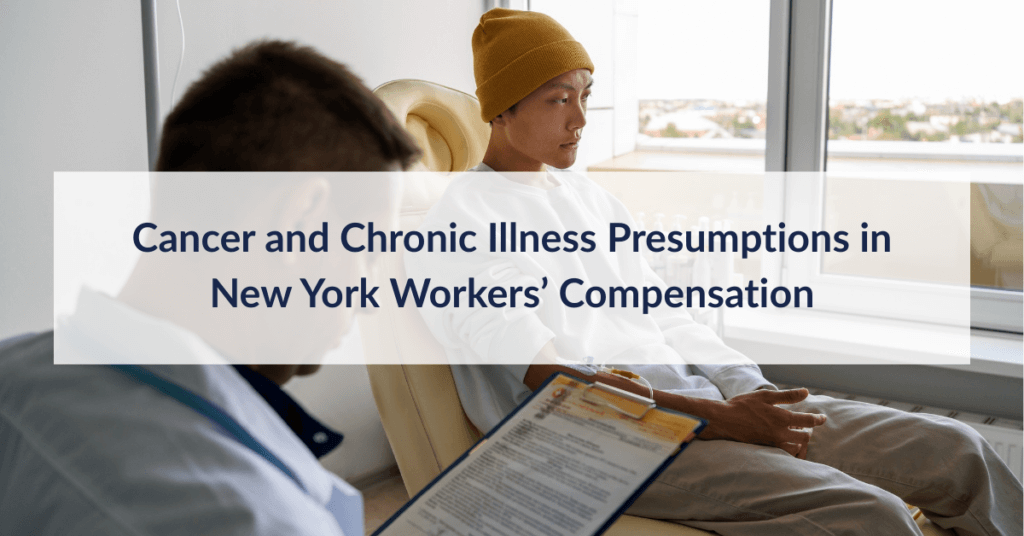
Workers’ compensation claims involving cancer and chronic illnesses are some of the most complex cases. Cancer and long-term diseases often develop slowly, sometimes years or even decades after exposure to hazardous substances on the job. This delay can make it difficult for injured workers to prove that their condition is directly related to their job, even when workplace exposure is a likely cause.
New York law tries to account for these challenges through presumptions built into the workers’ compensation system. In certain situations, the law assumes that a cancer or chronic illness is work-related if the worker’s job involved known risks or exposures. Instead of forcing the employee to prove causation, the law requires the employer or insurance carrier to show that the condition came from somewhere else.
Experienced New York workers’ comp lawyer Paul Giannetti helps workers with serious work-related illnesses seek the compensation they deserve. If you’ve recently been diagnosed with cancer or a chronic illness that you believe is work-related, our firm is here to help. Contact us today at (518) 346-7777 to discuss your case in a free consultation.
What Are Cancer and Chronic Illness Presumptions?
A presumption means that workers’ comp law starts from the assumption that an illness is work-related if certain conditions are met. Those conditions usually involve the kind of work the employee did and whether that work is known to involve dangerous exposures. The claim is not automatically approved, but the employer or insurance carrier must come forward with evidence proving that the condition was caused by something non-work-related.
These presumptions are typically rebuttable, meaning that an employer can challenge them. However, a rebuttal generally requires medical or factual evidence strong enough to overcome the legal assumption.
Legal Basis in New York
In New York, the primary legal basis for presumptions is found in Workers’ Compensation Law Section 47. This section recognizes that certain diseases are presumed to arise out of employment when a worker was employed in an occupation or process known to be associated with a certain disease. This law reflects a practical understanding of how occupational diseases develop and the difficulty of tracing them to a single exposure.
New York law also incorporates presumptions through more targeted provisions. One notable example involves World Trade Center-related illnesses, where state law requires the Workers’ Compensation Board to accept certain medical certifications as presumptive evidence that a condition is work-related. These provisions recognize that exposure in specific environments is already well-documented and does not need to be re-proven in every individual case.
Eligibility Criteria
Even though New York law recognizes presumptions for occupational diseases, not every claim automatically qualifies. Workers still have to meet specific eligibility requirements tied to their job duties, exposures, and medical conditions.
Jobs and Work Environments That May Qualify
Eligibility is not based on a job title alone. What matters is the work itself and the conditions under which it was performed.
New York looks at whether the employee worked in an environment known to involve harmful exposures, such as chemicals, smoke, dust, fumes, or other hazardous substances. Jobs in industrial settings, construction, manufacturing, emergency response, and similar fields are common in workers’ comp claims for occupational diseases.
The Workers’ Compensation Board focuses on what the worker actually did day to day. Two people with the same job title can end up with very different outcomes if one has regular exposure to hazardous conditions and the other does not.
Covered Conditions and Medical Requirements
The type of illness matters just as much as the type of work. Presumptions typically apply to diseases that have a recognized association with workplace exposures, including certain cancers and long-term respiratory or systemic conditions. Because these illnesses often develop slowly, New York law allows claims to be filed even when symptoms appear years after the exposure occurred.
Medical evidence is still required. Workers must show a diagnosis and establish that they did not suffer from the condition prior to the relevant employment. While the presumption eases the burden of proving causation, it does not eliminate the need for credible medical documentation linking the disease to the worker’s employment history.
Navigating the Claims Process
Filing a workers’ compensation claim for cancer or a chronic illness in New York can feel overwhelming. Even when a presumption applies, the process still follows formal steps, and missing one can slow things down or put a claim at risk. Here is an idea of what to expect when navigating the claims process.
Steps to Filing a Claim
The process usually starts once a worker becomes aware that their illness may be related to their job. In occupational disease cases, that moment is not always obvious. It may be the date of diagnosis or the point when a doctor connects the condition to workplace exposure.
From there, the worker must notify their employer and file a claim with the New York Workers’ Compensation Board using the appropriate employee claim form. The employer and its insurance carrier are then allowed to respond. Even in cases involving presumptions, insurers may challenge whether the worker meets the eligibility criteria or whether the presumption applies to the specific condition of the claim.
If there is a dispute, the Board may schedule hearings where medical records, employment history, and expert opinions are reviewed. The hearings are not trials in the traditional sense, but they do require preparation. Testimony from medical providers and detailed employment records can play a significant role in how the claim is resolved.
Documentation and Evidence
Although presumptions reduce the burden of proving causation, they do not replace the need for strong documentation. Medical records are central to any occupational disease claim. A clear diagnosis, treatment history, and physician opinions connecting the illness to workplace exposure can help establish the foundation of the case.
Employment records are also important. Workers may need to show where they worked, what their duties were, and how long they were exposed to potentially hazardous conditions. For workers covered under specific statutory programs (such as those involving World Trade Center-related illnesses), official medical certifications can carry significant weight. These documents may serve as presumptive evidence that the condition is work-related.
Employer Responsibilities
New York law places clear obligations on employers and their insurance carriers when an occupational disease claim is filed, especially when legal presumptions apply.
Legal Obligations Under New York Law
At a minimum, employers are required to carry workers’ compensation insurance and to report occupational disease claims once they are notified. When a claim involves a presumed cancer or chronic illness, employers and insurers cannot simply ignore the presumption or dismiss the claim out of hand. The law requires them to treat the condition as work-related unless they can produce credible evidence to rebut that presumption.
This means that if an employer or carrier wants to challenge the claim, they must do more than raise general doubts or point to non-work-related risk factors. To overcome a presumption, they typically need persuasive medical evidence showing that the illness was caused by something other than the employee’s work. Without that level of proof, the presumption stands.
Employers are also prohibited from retaliating against workers for filing a workers’ compensation claim. Employees who raise concerns about occupational illness or seek benefits are legally protected from adverse employment actions based on that decision.
Supporting Employees With Serious Illnesses
In addition to legal compliance, employers often face practical and human considerations when an employee is dealing with cancer or a chronic disease. Clear communication about the claims process, timely completion of required forms, and cooperation with medical evaluations can reduce stress for affected workers.
Employers may also need to consider workplace accommodations, modified duties, or extended leave when appropriate. How an employer responds during this period can have a lasting impact on the employee and the workplace as a whole.
When handled properly, employer involvement does not need to be adversarial. Following the law and engaging in the process in good faith helps the system work the way it’s supposed to, providing support when work puts people at risk of serious, long-term illnesses.
The Importance of Legal Guidance in Presumption Cases
Presumptions are meant to make the workers’ compensation system more accessible, but they don’t eliminate confusion. In practice, many workers are unaware that a presumption may apply to their condition at all. Others assume that because a presumption exists, their claim will move smoothly without challenge, only to be surprised when an insurance carrier disputes eligibility.
Legal guidance can be especially important in presumption cases because small details often determine whether the presumption applies. Issues like how a job is described, how exposure is documented, or when the worker is considered to have “known” their illness was work-related can all affect the outcome. Most workers are not equipped to handle these questions while also managing a serious illness.
Attorneys familiar with New York’s workers’ compensation system and occupational disease laws can help ensure claims are filed on time, supported with the right medical evidence, and framed in a way that clearly establishes the applicable presumption. They can also push back when employers or insurers try to shift the burden of proof back onto the worker despite the law’s protections.
Discuss Your Case With an Albany Workers’ Comp Lawyer
Cancer and chronic illness presumptions exist to protect workers facing some of the most difficult claims in the workers’ comp system. If you’re dealing with a serious work-related illness, don’t wait to seek legal guidance. Contact experienced Albany workers’ compensation lawyer Paul Giannetti today at (518) 346-7777 to learn more about your legal rights.